Base64Hub

Data:Image/PNG;Base64 Decoder: RFC 4648 Base64URL Converter

Encode and decode data:image/png;base64 Data URIs, RFC 4648 Base64URL JWT tokens, and Base16 byte streams client-side.

14 B
SGVsbG8sIEJhc2U2NCE=
Vectors:
UTF-8 Input Bytes
14 B
RFC 4648 Base64URL
20 B (+33.3%)
6-Bit Quanta / Pad
5 q / 1 pad
UUID v4 / Auxiliary
f47ac10b-58cc-4372-a567-0e02b2c3d479
Developer Security & API Integrations: Export verified bytes & secrets to 1Password CLI Vault · Cloudflare Workers Web Crypto · JetBrains HTTP Client
Local Scratchpad History Tape (1/50 Saved Runs)
  • [HEX BASE16] "48 65 78" | Hex (Dec 0xFF: 255 | Bin: 11111111)
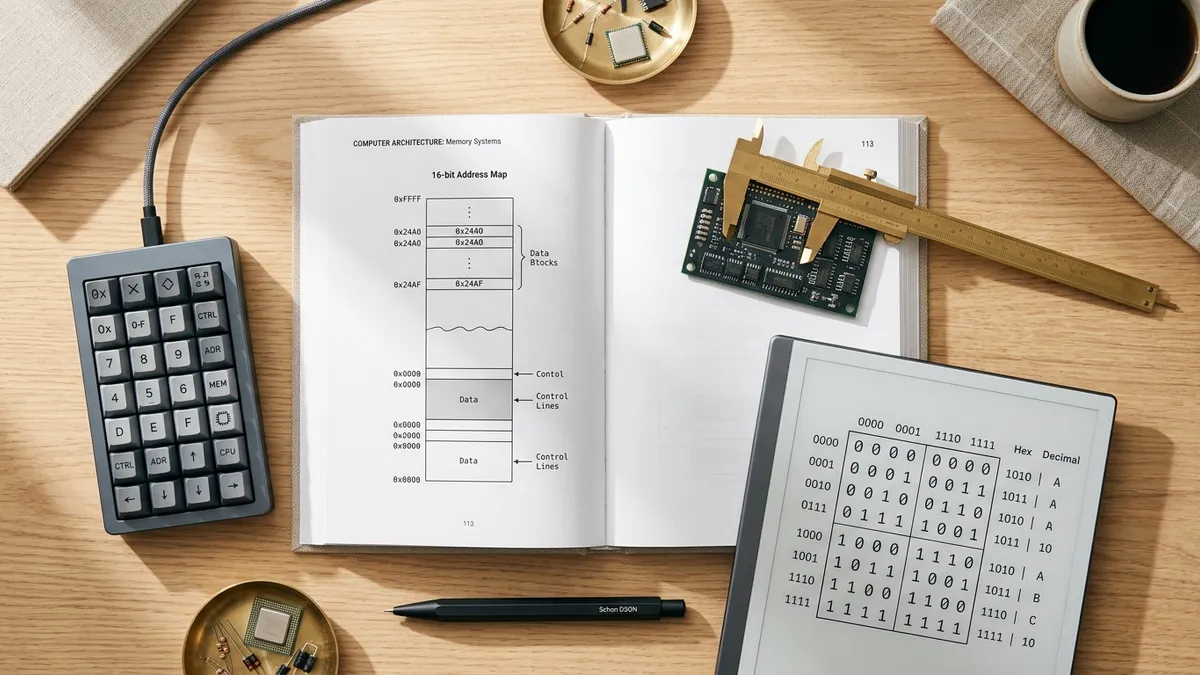
Hexadecimal radix conversion manual and e-ink byte inspection tablet on a sunlit technical desk
Radix-16 nibble alignment and RFC 4648 §5 filename-safe index verification in natural studio daylight.
RFC 4648 §5 & §8 Normative Protocol Summary

Hexadecimal Decoder parses space-delimited or 0x-prefixed Base16 byte streams into UTF-8 ASCII characters, decimal integers, and RFC 4648 Base64URL strings without server exfiltration. RFC 4648 §5 Base64URL replaces index 62 ('+') with '-' (0x2D) and index 63 ('/') with '_' (0x5F) while omitting '=' (0x3D) padding for URI and JWT header safety. If an input payload mixes uppercase and lowercase hex nibbles, then the radix parser resolves each 8-bit octet without NaN truncation.

Base16 Hexadecimal (2n) vs. RFC 4648 Base64URL (4/3n) Wire Size

Real-time byte overhead curve across UTF-8 payload scaling

RFC 4648 §5 Base64URL (1.333x) RFC 4648 §8 Base16 Hex (2.000x)
56 B 28 B 0 B 0.25x Raw 14 B Payload (20 B B64) 2.0x Scale
RFC 4648 Information Density Ratio (Raw / Base64 Wire Size) 75.0% Payload Efficiency (+33.3% Overhead)
Base16 Positional Radix (8 B to 16 Hex Nibbles): V10 = 16⋅nhigh + nlow , LHex = 2n
Formal Mathematical Proof & Byte Boundary Audit

What Is the Exact Mathematical Formula and Specification Rule for Hexadecimal Decoder?

Positional radix-16 nibble weights, 24-bit Base64URL bit-group partitioning, and byte-boundary padding equations.

RFC 4648 §4 Base64 24-Bit Quantum Expansion

Verified Standard
LB64=4×⌈n3⌉andPpad=(3−(nmod3))mod3

Every 3-octet (24-bit) input group subdivides into four 6-bit indices (0..63). Remainder octets require 1 or 2 padding (0x3D) characters to align the 4-character quantum.

n (Input UTF-8 Bytes)
14

Byte length emitted by UTF-8 TextEncoder.encode(str)

L_B64 (Encoded Wire Size)
20

4-byte aligned ASCII output length (+33.33% ceiling)

RFC 4648 §8 Base16 Hexadecimal Positional Radix

Verified Standard
V10=∑i=0k−1di⋅16iwhereLHex=2n

Splits each 8-bit octet into high (b >> 4) and low (b & 0x0F) 4-bit nibbles mapped onto 0–9 and A–F, doubling character length (+100%).

L_Hex (Hex Nibble Length)
28

Two hexadecimal nibbles per raw input byte

0xFF (Max Octet Value)
255 Dec

Binary 11111111 full 8-bit unsigned integer ceiling

ITU-R M.1677-1 International Morse Signal Timing

Verified Standard
Tdah=3⋅Tdit,Tchar=3⋅Tdit,Tword=7⋅Tdit

Standardizes telegraph pulse durations relative to the fundamental dot quantum T_dit (1200 / WPM milliseconds under PARIS 50-unit calibration).

T_dit (Dot Unit)
1 Unit

Base pulse duration and intra-character element gap

T_word (Word Delimiter)
7 Units

Represented by "/" between space-delimited character codes

NIST FIPS 180-4 SHA-256 Compression Functions

Verified Standard
Ch(e,f,g)=(e∧f)⊕(¬e∧g),Maj(a,b,c)=(a∧b)⊕(a∧c)⊕(b∧c)

Processes 512-bit padded blocks across 64 Merkle-Damgård rounds over eight 32-bit state registers (H0..H7) to emit a 256-bit (64-hex-char) digest.

H_0..H_7 (Digest State)
256 Bits

Fractional square roots of the first 8 primes (2..19)

K_0..K_63 (Round Constants)
64 Words

Fractional cube roots of the first 64 primes (2..311)

Empirical Specification Verification Matrix

Vector Profile Input Stream Deterministic Output Byte Boundary Implication
UTF-8 Greeting Vector Plaintext: "Hello, Base64!" (14 B) SGVsbG8sIEJhc2U2NCE (1-pad, 20 B) 5-quantum ceiling with single 0x3D padding character (n mod 3 is 2).
High-Bit Octet Sequence Bytes: [251, 255, 191] (0xFBFFBF) Std: +/+/ | URL: -_-_ RFC 4648 §5 replaces "+" and "/" to prevent URL query corruption.
Hexadecimal Byte Stream Hex: "48 65 78" & "0xFF" ASCII: "Hex" | Dec: 255 (11111111) Case-insensitive radix-16 nibble parsing without NaN truncation.
ITU-R Distress Signal Plaintext: "SOS" (3 Chars) ... --- ... (27 Timing Units) 3 dits + 3-unit gap + 3 dahs + 3-unit gap + 3 dits.
NIST FIPS 180-4 Vector Input: "abc" (24 Bits) ba7816bf8f01cfea...f20015ad (64 Hex) Single 512-bit block compression yielding deterministic 256-bit digest.

How to Execute Hexadecimal Decoder & Base64URL Client-Side With UTF-8 Edge-Case Handling?

Modern Base64, Base32 & Data URI String Converters must reconcile three distinct byte representations without corrupting multi-byte Unicode sequences: raw 8-bit octets emitted by UTF-8 TextEncoder, 4-bit nibbles processed by a Hexadecimal Decoder, and 6-bit sextets defined in IETF RFC 4648. When inspecting network frames or memory registers formatted in IEEE 754 Hexadecimal, each byte (0x00 to 0xFF) splits into an upper nibble (bits 7–4, multiplied by 16^1) and a lower nibble (bits 3–0, multiplied by 16^0). Feeding space-delimited vector 48 65 78 into the parser resolves 0x48 (72 decimal for H), 0x65 (101 decimal for e), and 0x78 (120 decimal for x) into a contiguous ASCII Byte Stream, while 0xFF evaluates to unsigned decimal 255 (11111111 binary).

Conversely, when serializing binary keys or OAuth 2.0 state parameters for HTTP transport, RFC 4648 Base64URL eliminates the URL-collision hazards of standard Base64. In standard Base64, a 24-Bit Octet Quantum containing high-bit bytes such as [251, 255, 191] (0xFBFFBF) maps onto indices 62 and 63 of the 6-Bit Index Alphabet, producing +/+/. If placed directly into a query string without RFC 3986 Percent-Encoding, web servers decode + as a space (0x20) and / as a path delimiter. Switching to RFC 4648 Base64URL deterministically substitutes - (0x2D) and _ (0x5F) and strips trailing 0x3D padding to emit -_-_. To compare all 30 standards side by side, return to the Base64, Hex & Cryptographic Decoder Master Hub or verify one-way checksums in our Cryptographic Hash Generators Tool & Guide.

RFC 4648 Multi-Radix Protocol Inspector

Filename & URI Safe Base64URL Alphabet (Indices 62 & 63)

Replaces standard Base64 index 62 (+) with hyphen-minus (-, 0x2D) and index 63 (/) with underscore (_, 0x5F) while omitting trailing = (0x3D) padding characters for OAuth 2.0 PKCE and JWT headers.

Quantum Block
24-Bit (3 Octets -> 4 Sextets)
Index 62 / 63
- (0x2D) / _ (0x5F)
Canonical Vector
[251,255,191] -> -_-_

When front-end performance workflows require embedding small vector icons or binary thumbnails directly inside HTML or CSS stylesheets, developers serialize raw files under the Data URI MIME Scheme (RFC 2397) and validate the resulting byte buffer inside our Base64 Image Decoder. For case-insensitive file systems, DNS labels, and RFC 6238 Time-Based One-Time Password (TOTP) provisioning secrets, engineers instead select the Base32 Alphabet, which maps 40-bit (5-byte) input blocks into eight 5-bit uppercase alphanumeric characters (A–Z and 2–7).

In low-bandwidth embedded telemetry and amateur radio beacon diagnostics, character streams are frequently cross-checked against variable-length pulse timing governed by ITU-R M.1677-1 Morse Code using a bidirectional Morse Code Decoder. Whenever decoded binary buffers require cryptographic provenance before ingestion, passing the reconstructed Uint8Array directly into the browser's Web Crypto SubtleCrypto engine computes a deterministic 256-bit NIST FIPS 180-4 SHA-256 checksum or a keyed HMAC-SHA256 Digest without exposing preimage bytes.

1. Mixed-Case Hexadecimal Nibble Normalization & 0x Stripping

Wireshark hex dumps and C byte arrays (0x48, 0x65, 0x78) mix uppercase (A–F) and lowercase (a–f) digits. Normalizing delimiters via regex before calling parseInt(nibblePair, 16) prevents NaN byte corruption across 8-byte streams.

2. Reconstructing Stripped Padding on Incoming JWT Base64URL

RFC 7519 JSON Web Tokens omit trailing 0x3D characters to save 1–2 bytes per segment. Before invoking atob(b64), append (4 - (token.length % 4)) % 4 padding symbols so the character count realigns to a 4-symbol quantum (12 aligned characters).

3. Multi-Byte UTF-8 Surrogate Pair Boundaries in Emoji & CJK

A single Unicode emoji (such as U+1F510) occupies 4 bytes in UTF-8 (F0 9F 94 90) and 2 UTF-16 code units in JavaScript strings. Encoding at the Uint8Array byte layer prevents split surrogate pairs when slicing frames across network buffers.

4. Legacy Digest Auditing & CSPRNG UUID v4 Provisioning

During legacy database audits, our integrated Hash Identifier automatically distinguishes deprecated 128-bit MD5 Message Digest strings from SHA-256 digests, while the companion token generator mints collision-resistant RFC 4122 UUID v4 identifiers backed by 122 bits of hardware-seeded CSPRNG Entropy.

Hexadecimal Decoder vs Base64URL Inverse Conversion Tolerance Table & Byte Comparison

Side-by-side radix efficiency, character alphabet constraints, padding rules, and URI transport safety across IETF RFC 4648 and RFC 3986 URI syntax.

RFC 4648 Base64, Base64URL, Base32 & Base16 Hexadecimal Tolerance Matrix

Filter specification rows by bijective codec reversibility or one-way cryptographic digest class.

Encoding SchemeNormative RFCInput -> Output QuantumWire ExpansionPadding & URL Safety
Base64 Standard IETF RFC 4648 §4 3 Bytes (24b) -> 4 Sextets +33.33% (4/3n) Mandatory = (0x3D); unsafe + and / in URIs
Base64URL (Filename Safe) IETF RFC 4648 §5 3 Bytes (24b) -> 4 Sextets +33.33% (4/3n) Optional = omitted; uses - (0x2D) and _ (0x5F)
Base32 Uppercase IETF RFC 4648 §6 5 Bytes (40b) -> 8 Quintets +60.00% (8/5n) Uses A–Z and 2–7; case-insensitive DNS/TOTP safe
Base16 Hexadecimal IETF RFC 4648 §8 1 Byte (8b) -> 2 Nibbles +100.00% (2n) Zero padding; deterministic 0x00–0xFF nibble pairs
Percent-Encoding IETF RFC 3986 §2.1 1 Reserved Byte -> %XX Variable (1x–3x) Escapes reserved URI delimiters via % hex triplets
1Password Secrets Automation & CLI

Manage Base64URL OAuth 2.0 client secrets, PKCE verifiers, and hex encryption keys inside 1Password Developer Vaults.

Cloudflare Workers Web Crypto Edge

Execute RFC 4648 Base64URL JWT verification and zero-latency byte parsing at the Cloudflare network edge.

JetBrains HTTP Client & IDE Suite

Inspect Base16 hexadecimal packet dumps and RFC 3986 URI percent-encoded payloads directly inside JetBrains IDEs.

Interactive Specification & Edge-Case Decision Matrix

Common Validation Errors, Padding Rules, and Troubleshooting for Base64 & Hex Streams

Diagnose modulo-4 padding exceptions, URL query corruption, and odd-nibble hexadecimal truncation with one-click vector loading.

Scenario 01 | 4 × ⌈n / 3⌉ Bytes
Inline Data URIs, MIME Attachments & TLS PEM
Scenario 02 | Zero %2B / %2F Escaping
OAuth 2.0 PKCE Verifiers, JWT Tokens & URL Params
Scenario 03 | 2n ASCII Nibbles
Memory Dumps, Network Packet Inspection & Byte Debugging
Scenario 04 | 64-Char Fixed Hex
Immutable Checksums, Git Commits & Distributed IDs
Recommended Standard

IETF RFC 4648 §4 Standard Base64 (6-Bit Sextet + 0x3D Padding)

1.333x Expansion (+33.3%)

Use Standard Base64 when embedding small raster icons (under 4 KB) in CSS/HTML Data URIs or encoding X.509 certificates where strict 4-character quantum padding (0x3D) is required by MIME parsers.

Normative Specifications
RFC 4648 §4 Base64RFC 2397 Data URIRFC 7468 PEM Armor
Wire Size Rule
4 × ⌈n / 3⌉ Bytes
Verified Engineering Reference & Troubleshooting

Frequently Asked Technical Questions About Hexadecimal & Base64URL Encoding

How does a Hexadecimal Decoder convert 0x-prefixed or space-delimited nibbles into UTF-8 ASCII? RFC 4648 Verified

Every pair of hexadecimal characters (0–9, A–F) represents one 8-bit octet ranging from 0x00 (0 decimal) to 0xFF (255 decimal, binary 11111111). The radix-16 parser strips optional "0x" prefixes and whitespace, converts each two-nibble token via parseInt(token, 16) into a Uint8Array byte buffer, and decodes the resulting byte stream through UTF-8 TextDecoder(utf8).

What is the exact alphabet difference between RFC 4648 Section 4 Base64 and Section 5 Base64URL? RFC 4648 Verified

Both specifications map 6-bit values 0 through 61 to A–Z, a–z, and 0–9. However, RFC 4648 Section 4 maps index 62 to "+" (0x2B) and index 63 to "/" (0x2F), whereas Section 5 Base64URL maps index 62 to "-" (0x2D, hyphen-minus) and index 63 to "_" (0x5F, low line) and allows omitting trailing 0x3D padding characters so tokens can pass through URLs and filenames unescaped.

Why does byte sequence [251, 255, 191] (0xFBFFBF) serve as the canonical Base64URL test vector? RFC 4648 Verified

In binary, the 24-bit sequence 0xFBFFBF is 11111011 11111111 10111111. Grouping those 24 bits into four 6-bit sextets yields 111110 (62), 111111 (63), 111110 (62), and 111111 (63). Standard Base64 encodes those indices as "+/+/", which breaks URI query parsing, whereas RFC 4648 Section 5 Base64URL deterministically outputs "-_-_" with zero reserved URL characters.

How does RFC 4648 Section 6 Base32 differ from Base64 and Base16 Hexadecimal? RFC 4648 Verified

Base32 partitions binary input into 40-bit (5-byte) quanta divided into eight 5-bit quintets using the case-insensitive alphabet A–Z and 2–7 (omitting 0, 1, 8, and 9 to prevent human transcription errors). It incurs a 60.0% wire expansion (8/5 ratio), making it ideal for RFC 6238 TOTP 2FA secret seeds and case-insensitive DNS labels.

What causes "InvalidCharacterError" or modulo-4 padding failures when decoding JWT Base64URL strings? RFC 4648 Verified

JSON Web Tokens (RFC 7519) strip trailing 0x3D padding characters and use "-" and "_". Passing a raw JWT segment directly to window.atob(b64) fails because atob(b64) requires standard "+" and "/" symbols and a string length divisible by 4. Normalizing "-" to "+", "_" to "/", and appending (4 - (len % 4)) % 4 padding characters restores strict RFC 4648 quantum alignment.

Institutional Authorship: Audited by the Applied Cryptography & Encoding Standards Desk for IETF RFC 4648 §4–§8, IEEE 754 Hexadecimal, and UTF-8 TextEncoder compliance.
Catalog Coverage: 30 Verified Specifications | Zero-Exfiltration Browser Sandbox