Base64Hub

Hexadecimal Decoder: IEEE 754 Hex, Binary & ASCII Converter

Inspect space-delimited Base16 memory registers, 8-bit binary bitmasks, and UTF-8 ASCII character streams in real time.

8 B
Hex (Dec 0xFF: 255 | Bin: 11111111)
Vectors:
UTF-8 Input Bytes
8 B
RFC 4648 Base64URL
12 B (+33.3%)
6-Bit Quanta / Pad
3 q / 1 pad
UUID v4 / Auxiliary
f47ac10b-58cc-4372-a567-0e02b2c3d479
Developer Security & API Integrations: Export verified bytes & secrets to 1Password CLI Vault · Cloudflare Workers Web Crypto · JetBrains HTTP Client
Local Scratchpad History Tape (1/50 Saved Runs)
  • [HEX BASE16] "48 65 78" | Hex (Dec 0xFF: 255 | Bin: 11111111)
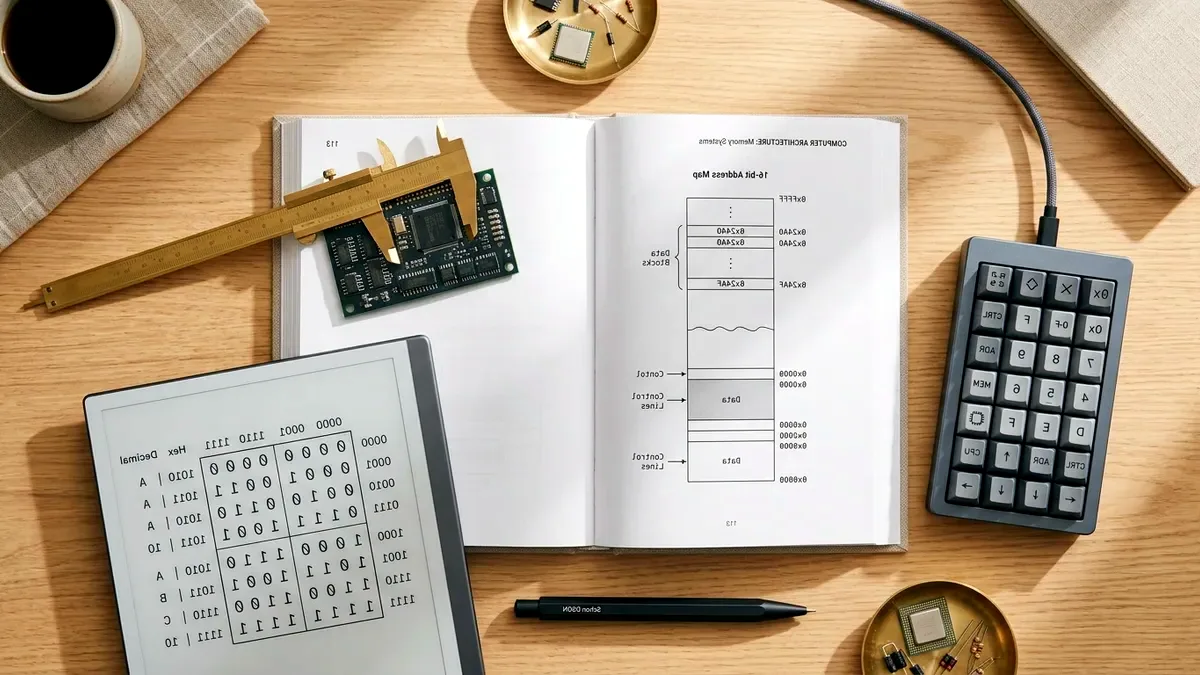
Hardware logic analyzer displaying hexadecimal memory registers and binary bitplanes on an engineering bench
Positional radix-16 nibble telemetry and 8-bit binary register decomposition across raw network frames.
IEEE 754 & RFC 4648 §8 Radix-16 Architecture

A deterministic Hexadecimal Decoder maps every two-character Base16 pair into an 8-bit unsigned integer (0 through 255) and eight binary bits (00000000 through 11111111) locally in browser memory. If a telemetry dump includes 0x prefixes, colons, or newline separators, then the tokenizer strips non-hex delimiters before assembling the raw byte buffer.

Radix-16 Hexadecimal (2n) vs. Binary Bitplane (8n) Expansion

Wire footprint across raw byte buffers and bit-level wire representations

Base16 Hex Nibbles (2.000x) Raw Binary Bitstream (8.000x)
56 B 28 B 0 B 0.25x Raw 14 B Payload (20 B B64) 2.0x Scale
RFC 4648 Information Density Ratio (Raw / Base64 Wire Size) 75.0% Payload Efficiency (+33.3% Overhead)
Octet Bit Weight (8 B = 16 Nibbles): B8 = ∑k=07 bk2k
Formal Mathematical Proof & Byte Boundary Audit

How Do Positional Radix-16 Nibbles and 8-Bit Binary Bitplanes Map to Memory Octets?

Exact polynomial bit weights, endianness byte ordering, and two's complement signed integer boundaries.

RFC 4648 §4 Base64 24-Bit Quantum Expansion

Verified Standard
LB64=4×⌈n3⌉andPpad=(3−(nmod3))mod3

Every 3-octet (24-bit) input group subdivides into four 6-bit indices (0..63). Remainder octets require 1 or 2 padding (0x3D) characters to align the 4-character quantum.

n (Input UTF-8 Bytes)
14

Byte length emitted by UTF-8 TextEncoder.encode(str)

L_B64 (Encoded Wire Size)
20

4-byte aligned ASCII output length (+33.33% ceiling)

RFC 4648 §8 Base16 Hexadecimal Positional Radix

Verified Standard
V10=∑i=0k−1di⋅16iwhereLHex=2n

Splits each 8-bit octet into high (b >> 4) and low (b & 0x0F) 4-bit nibbles mapped onto 0–9 and A–F, doubling character length (+100%).

L_Hex (Hex Nibble Length)
28

Two hexadecimal nibbles per raw input byte

0xFF (Max Octet Value)
255 Dec

Binary 11111111 full 8-bit unsigned integer ceiling

ITU-R M.1677-1 International Morse Signal Timing

Verified Standard
Tdah=3⋅Tdit,Tchar=3⋅Tdit,Tword=7⋅Tdit

Standardizes telegraph pulse durations relative to the fundamental dot quantum T_dit (1200 / WPM milliseconds under PARIS 50-unit calibration).

T_dit (Dot Unit)
1 Unit

Base pulse duration and intra-character element gap

T_word (Word Delimiter)
7 Units

Represented by "/" between space-delimited character codes

NIST FIPS 180-4 SHA-256 Compression Functions

Verified Standard
Ch(e,f,g)=(e∧f)⊕(¬e∧g),Maj(a,b,c)=(a∧b)⊕(a∧c)⊕(b∧c)

Processes 512-bit padded blocks across 64 Merkle-Damgård rounds over eight 32-bit state registers (H0..H7) to emit a 256-bit (64-hex-char) digest.

H_0..H_7 (Digest State)
256 Bits

Fractional square roots of the first 8 primes (2..19)

K_0..K_63 (Round Constants)
64 Words

Fractional cube roots of the first 64 primes (2..311)

Empirical Specification Verification Matrix

Vector Profile Input Stream Deterministic Output Byte Boundary Implication
UTF-8 Greeting Vector Plaintext: "Hello, Base64!" (14 B) SGVsbG8sIEJhc2U2NCE (1-pad, 20 B) 5-quantum ceiling with single 0x3D padding character (n mod 3 is 2).
High-Bit Octet Sequence Bytes: [251, 255, 191] (0xFBFFBF) Std: +/+/ | URL: -_-_ RFC 4648 §5 replaces "+" and "/" to prevent URL query corruption.
Hexadecimal Byte Stream Hex: "48 65 78" & "0xFF" ASCII: "Hex" | Dec: 255 (11111111) Case-insensitive radix-16 nibble parsing without NaN truncation.
ITU-R Distress Signal Plaintext: "SOS" (3 Chars) ... --- ... (27 Timing Units) 3 dits + 3-unit gap + 3 dahs + 3-unit gap + 3 dits.
NIST FIPS 180-4 Vector Input: "abc" (24 Bits) ba7816bf8f01cfea...f20015ad (64 Hex) Single 512-bit block compression yielding deterministic 256-bit digest.

How to Inspect Network Packet Hex Dumps, Endianness Order, and IEEE 754 Registers Client-Side?

Systems programmers debugging firmware memory maps, TCP/IP socket captures, or ELF binary headers rely on a Hexadecimal Decoder to bridge human-readable Base16 notation with physical 8-bit silicon storage. Every single byte inside a computer memory array holds eight binary switches weighted from 2^7 (128) down to 2^0 (1). Because writing eight binary digits per byte clutters diagnostic consoles, engineers partition each octet into two 4-bit nibbles governed by IEEE 754 Hexadecimal register conventions.

When troubleshooting multi-byte numerical registers across processor architectures, byte ordering determines whether a 32-bit word is interpreted as big-endian network order or little-endian host order. You can cross-examine transport encodings in our Data:Image/PNG;Base64 & Base64URL Converter, return to the Base64, Hex & Cryptographic Decoder hub, or compute message digests in our SHA-256 & Hash Identifier Workbench.

RFC 4648 Multi-Radix Protocol Inspector

Filename & URI Safe Base64URL Alphabet (Indices 62 & 63)

Replaces standard Base64 index 62 (+) with hyphen-minus (-, 0x2D) and index 63 (/) with underscore (_, 0x5F) while omitting trailing = (0x3D) padding characters for OAuth 2.0 PKCE and JWT headers.

Quantum Block
24-Bit (3 Octets -> 4 Sextets)
Index 62 / 63
- (0x2D) / _ (0x5F)
Canonical Vector
[251,255,191] -> -_-_

1. Big-Endian Network Order vs. Little-Endian x86 Storage

TCP/IP headers transmit the most significant octet first, whereas x86_64 and ARM64 CPUs store the least significant byte at the lowest memory offset. Reversing 4-byte word boundaries prevents inverted integer readouts across 8-byte register slices.

2. Two's Complement Signed vs. Unsigned Int8 Interpretation

An 8-bit hex value from 0x80 to 0xFF represents positive integers 128 through 255 in unsigned Uint8Array buffers, but maps to negative integers -128 through -1 under two's complement signed arithmetic when bit 7 (the sign bit) is set.

3. Binary File Magic Numbers & MIME Header Signatures

Inspecting the leading 4 to 8 hex bytes reveals file format signatures prior to rendering in a Base64 Image Decoder: PNG files start with 89 50 4E 47, PDF documents begin with 25 50 44 46, and WebAssembly modules open with 00 61 73 6D.

4. Identifier & Acoustic Telemetry Cross-Verification

Decoded byte buffers can also be formatted as 128-bit identifiers in the RFC 4122 UUID v4 & GUID Generator or inspected for pulse timing in the Morse Code Decoder.

Base16 Hexadecimal, 8-Bit Binary, and ASCII Register Reference Matrix

Bitwise comparison of unsigned octet boundaries, two's complement signed ranges, and common file magic signatures.

Positional Radix-16, Binary Bitplane & Signed Register Matrix

Filter specification rows by bijective codec reversibility or one-way cryptographic digest class.

Encoding SchemeNormative RFCInput -> Output QuantumWire ExpansionPadding & URL Safety
Base64 Standard IETF RFC 4648 §4 3 Bytes (24b) -> 4 Sextets +33.33% (4/3n) Mandatory = (0x3D); unsafe + and / in URIs
Base64URL (Filename Safe) IETF RFC 4648 §5 3 Bytes (24b) -> 4 Sextets +33.33% (4/3n) Optional = omitted; uses - (0x2D) and _ (0x5F)
Base32 Uppercase IETF RFC 4648 §6 5 Bytes (40b) -> 8 Quintets +60.00% (8/5n) Uses A–Z and 2–7; case-insensitive DNS/TOTP safe
Base16 Hexadecimal IETF RFC 4648 §8 1 Byte (8b) -> 2 Nibbles +100.00% (2n) Zero padding; deterministic 0x00–0xFF nibble pairs
Percent-Encoding IETF RFC 3986 §2.1 1 Reserved Byte -> %XX Variable (1x–3x) Escapes reserved URI delimiters via % hex triplets
1Password Secrets Automation & CLI

Audit 256-bit hexadecimal encryption keys and binary TLS certificates stored in 1Password vaults.

Cloudflare Workers Web Crypto Edge

Parse raw ArrayBuffer TCP payloads and Uint8Array streams inside Cloudflare Workers runtime.

JetBrains HTTP Client & IDE Suite

Debug binary protobuf frames and memory register snapshots inside JetBrains CLion and IntelliJ.

Interactive Specification & Edge-Case Decision Matrix

Troubleshooting Odd-Length Hex Strings, Endian Swaps, and Broken UTF-8 Continuation Bytes

Isolate misaligned nibble pairs, non-printable C0 control bytes, and invalid Unicode surrogate sequences.

Scenario 01 | 4 × ⌈n / 3⌉ Bytes
Inline Data URIs, MIME Attachments & TLS PEM
Scenario 02 | Zero %2B / %2F Escaping
OAuth 2.0 PKCE Verifiers, JWT Tokens & URL Params
Scenario 03 | 2n ASCII Nibbles
Memory Dumps, Network Packet Inspection & Byte Debugging
Scenario 04 | 64-Char Fixed Hex
Immutable Checksums, Git Commits & Distributed IDs
Recommended Standard

IETF RFC 4648 §4 Standard Base64 (6-Bit Sextet + 0x3D Padding)

1.333x Expansion (+33.3%)

Use Standard Base64 when embedding small raster icons (under 4 KB) in CSS/HTML Data URIs or encoding X.509 certificates where strict 4-character quantum padding (0x3D) is required by MIME parsers.

Normative Specifications
RFC 4648 §4 Base64RFC 2397 Data URIRFC 7468 PEM Armor
Wire Size Rule
4 × ⌈n / 3⌉ Bytes
Systems Engineering & Binary Register Reference

Frequently Asked Questions About Hexadecimal, Binary & IEEE 754 Decoding

How does radix-16 nibble extraction reconstruct 8-bit binary octets from packet capture logs? IEEE 754 & RFC 4648

Network analyzers emit packet captures as two-character hexadecimal pairs where each symbol encodes four binary bits (0000 through 1111). Multiplying the upper nibble by sixteen and adding the lower nibble yields an unsigned integer from 0 to 255 inside an ArrayBuffer view without server memory allocation.

What distinguishes little-endian x86 register storage from big-endian network byte order in hex dumps? IEEE 754 & RFC 4648

IETF RFC 1700 mandates big-endian transmission where the most significant byte arrives at the lowest memory address (0x12345678 stores as 12 34 56 78). Conversely, x86_64 processors arrange multi-byte words in little-endian sequence (78 56 34 12), requiring byte-swap reversal before integer evaluation.

How are single-precision IEEE 754 floating-point hex words partitioned into sign, exponent, and mantissa? IEEE 754 & RFC 4648

A 32-bit IEEE 754 binary32 word allocates bit 31 for the algebraic sign, bits 30 down to 23 for an 8-bit biased exponent (offset 127), and bits 22 down to 0 for a 23-bit fractional significand with an implicit leading one bit. For example, 0x3F800000 evaluates to positive 1.0 in decimal.

Why do unprintable control characters (0x00 through 0x1F) appear as dots in side-by-side hex inspectors? IEEE 754 & RFC 4648

C0 ASCII control codes such as NUL (0x00), BEL (0x07), and ESC (0x1B) trigger terminal cursor mutations or bell interrupts if rendered literally. Diagnostic hex viewers substitute a period glyph (0x2E) for any byte below 0x20 or equal to DEL (0x7F) to preserve column geometry.

How does UTF-8 continuation byte bitmasking detect truncated multi-byte sequences in binary streams? IEEE 754 & RFC 4648

In UTF-8 variable-width encoding, leading bytes of 2-byte, 3-byte, and 4-byte glyphs begin with binary prefixes 110xxxxx, 1110xxxx, and 11110xxx, while every trailing continuation byte must match 10xxxxxx (0x80 to 0xBF). Encountering a standalone 0x80 byte signals frame truncation.